
Friday, March 30, 2007
After around 30 people died on Thursday, terrified residents said there was no let-up in the fighting across the bullet-scarred city on the Indian Ocean coast.
"A mortar has just fallen into the house next to me. We can hear crying and can see smoke," Faisal Jamah, a resident of south Mogadishu, said by telephone. "We barely slept last night. The sky was lit up by shelling all night."
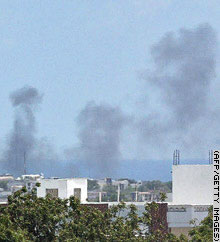 |
| Smoke rises from the vicinity of the International Airport of Mogadishu on Friday where an Ethiopian helicopter was reportedly shot down by insurgents. |
'It lost altitude fast'
A Reuters witness said he saw from the roof of his house two Ethiopian helicopters firing at an insurgent stronghold, before one was hit by a missile. "The sound of the engine changed, then a trail of white smoke came out as it lost altitude fast. I lost sight of it in the direction of the airport," he said.
At least 100 people were wounded on Thursday, and the toll of deaths and injuries looked certain to rise. Smoke billowed from houses, and explosions sounded around the city.
"There are a lot of wounded, but there is no way to take them to the hospitals due to the fighting on the roads," Jamah added as gunfire echoed around the streets on Friday morning.
Tens of thousands of Mogadishu residents have fled the city, many piling their possessions onto donkey-carts.
With some of the clan militia who used to run the lawless city fighting alongside the Islamists, the violence has left a ceasefire between the Ethiopian military and the city's main clan, the Hawiye, in tatters.
Analysts said Ethiopia appeared bent on an all-out push against the insurgents, who have been emboldened by recent strikes including the downing of an airplane serving an African peacekeeping mission, and the killing of soldiers.
Local broadcaster Shabelle said machine-gun fire was echoing since dawn around the area of Mogadishu's football stadium, where Ethiopian soldiers and insurgents had dug trenches just a few metres from each other.
"The sound of heavy artilleries could be heard in all parts of the capital city while panic-stricken civilians are still fleeing from the city," Shabelle said on its Web site.
The private media network added that at least 30 people had died in Thursday's fighting. Reuters verified at least 28.
Moderates invited to peace conference
Prime Minister Ali Mohamed Gedi said, however, that a reconciliation conference scheduled to start in mid-April was still on track. Moderate Islamists would be invited, he said.
"Those who renounce violence and recognize the Transitional Federal Charter can participate," he told the BBC from Riyadh, referring to the charter under which his government was established in neighboring Kenya in 2004.
The mandate for the government, which was set up in the 14th attempt to restore central rule to Somalia since 1991, runs out in 2009, after which in theory there should be elections.
Gedi denied security was deteriorating even further in Mogadishu. "This is what the mass media is spreading, but the reality is different," he said.
But reporters are witnessing ever more violent scenes.
The African Union (AU) has sent 1,200 Ugandan troops to help pacify Somalia. But they have also been attacked in a nation that defied a U.N.-U.S. peacekeeping mission in the early 1990s.
Other African nations are balking at sending further troops needed to boost the AU force to its planned strength of 8,000.
Source: Reuters, Mar 30, 2007