
Monday December 15, 2025
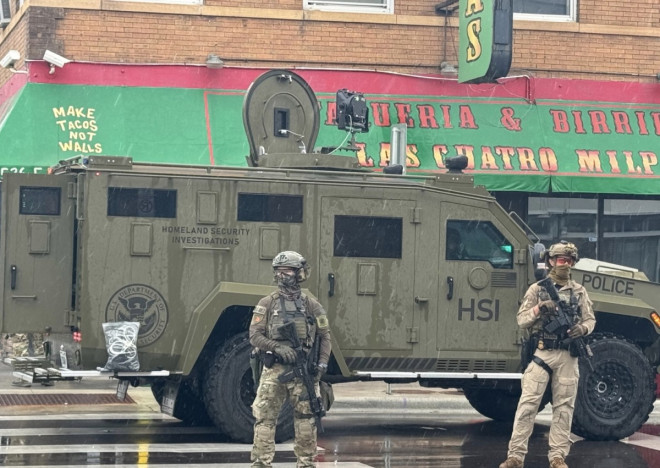
Federal agents with U.S. Immigration and Customs Enforcement, including Homeland Security Investigations officers, stand outside a restaurant during an enforcement operation in Minneapolis, Minnesota. CREDIT: Councilmember Jason Chavez
MINNEAPOLIS, Minn (HOL) — As federal immigration raids intensify across Minnesota, Somali families in Cedar-Riverside, on Lake Street and in Rochester are drawing up “know your rights” plans, teaching children not to open the door to strangers and keeping key phone numbers and documents ready in case a parent is detained.
Since the launch of “Operation Metro Surge” on Dec. 1, Immigration and Customs Enforcement says it has arrested more than 400 people in the Twin Cities and other cities, focusing on what it calls “criminal illegal aliens.” Somali and Latino communities say the operation has spread fear far beyond that target and has even swept up U.S. citizens.
Those clashes have pushed Somali Minnesotans to do what they can in their own homes, workplaces and streets: learn their rights, prepare for the worst and organize support networks.
This article is a general guide, not legal advice. Anyone facing arrest, detention or deportation should consult a qualified immigration lawyer or legal aid group in Minnesota.
---
Raids and rhetoric heighten fear
Somalis are the largest African diaspora community in Minnesota, concentrated in neighborhoods such as Minneapolis’ Cedar-Riverside and around Lake Street, as well as in parts of St. Paul and Rochester. Most are U.S. citizens or lawful permanent residents.
In recent weeks:
* Somali- and Latino-owned businesses at Karmel Mall, Plaza Mexico and along Lake Street have reported sharp drops in customers as people stay home to avoid ICE activity.
* Students at the University of Minnesota and Augsburg University say they now carry passports or IDs to class, avoid lingering in public spaces and track each other’s locations by phone.
* Protesters have gathered outside the Bishop Henry Whipple Federal Building at Fort Snelling, chanting against detention and deportation.
* Unions have condemned deportation flights from Minneapolis-St. Paul International Airport, accusing private contractors of profiting from “ripping families apart.”
* Gov. Tim Walz has asked DHS to review recent arrests of U.S. citizens and warned that “unlawful practices” by federal agents will not be tolerated in Minnesota.
The enforcement surge has coincided with an escalation in President Donald Trump’s language about Somalis. In recent weeks he has called Somalis “garbage,” described Somalia as “filthy, dirty, disgusting, ridden with crime” and vowed to “permanently pause” migration from what he calls “Third World” and “hellhole” countries.
Community leaders say those statements reinforce the sense that Somali Minnesotans are being treated as suspect even when they hold U.S. passports.
---
At home: what to do when agents knock
Under U.S. law, including in Minnesota, immigration officers generally cannot enter a private home without either consent from an adult resident or a warrant signed by a judge. Rights advocates say that rule is often not explained to the families most affected by raids.
If ICE or other officers knock at your door, they recommend several basic steps.
Do not open the door
* Do not open the door, even partway. Opening it can be treated as consent to enter.
* Speak through the door or a window.
* Ask officers to identify themselves and state which agency they represent.
* Ask for their names and badge numbers and write them down or record them if it is safe.
Ask to see any warrant without opening the door
If officers say they have a warrant, you can ask them to slide it under the door or hold it up to a window.
A valid judicial warrant should:
* Be signed by a judge, not only by an ICE supervisor.
* Clearly list your full name and correct address.
* Specify what places can be searched or who can be arrested.
ICE also uses “administrative warrants” signed by its own officials. Those documents do not give agents the power to force their way into a private home in Minnesota.
If the paper is not signed by a judge, or the name and address do not match your home, you can say: “I do not consent to a search. Please leave.”
Use your right to remain silent
You do not have to answer questions about:
* Your immigration status
* Where you were born
* How you entered the United States
If officers question you, rights organizations advise repeating:
“I am using my right to remain silent and I want to speak to a lawyer.”
Advocates recommend printing that sentence in English and Somali and keeping it near the door so it is easy to read out loud if you feel nervous.
Do not sign documents on the spot
Officers may show forms that waive the right to see a judge or ask you to agree to leave the country “voluntarily.”
Do not sign any document you do not fully understand.
You can say:
“I will not sign anything until I have spoken to a lawyer.”
Document what happens and call for help
If it is safe to do so:
* Record video or audio on your phone.
* Take photos of badges, vehicles and license plates.
* Write down the date, time and what officers say and do.
In Minnesota, community groups urge people to call a rapid-response line if ICE is at a home, workplace or in the neighborhood:
* Unidos MN know-your-rights line: (651) 372-8642
* Rapid-response line: (612) 441-2881
Volunteers staffing those lines can help document raids and connect families with lawyers.
---
At work: limits on what ICE can do
Federal agents have targeted workplaces in earlier operations, including meatpacking plants and retail corridors in Minnesota. Under Operation Metro Surge, advocates expect more job-site visits.
Under U.S. law:
* ICE can usually enter public areas such as customer dining rooms, shop floors open to the public, lobbies and parking lots.
* ICE cannot enter employee-only spaces without either a warrant signed by a judge or permission from the employer.
Workers and employers are encouraged to:
* Mark staff-only zones clearly with signs such as “Employees only.”
* Decide in advance who is authorized to speak with officers.
* Train staff on how to respond if agents arrive.
If ICE comes to your workplace:
* Do not run. Running can be cited as a reason to chase or arrest you.
* Your employer cannot force you to line up so ICE can question you.
* You have the right to remain silent about your immigration status, nationality and travel history.
* Do not sign any documents from ICE until you have consulted a lawyer.
---
On the street or in public: being stopped or detained
Operation Metro Surge has also led to encounters away from homes and workplaces. In Minnesota, people have reported being detained on sidewalks, in restaurants and while observing federal operations.
Advocates say three basic steps apply.
Ask if you are free to go
If officers stop you, you can ask:
“Am I under arrest, or am I free to go?”
If they say you are free to go, walk away slowly and calmly. If they say you are under arrest or being detained, you have the right to know the reason.
Repeat your right to remain silent
You can say:
“I am using my right to remain silent and I want to speak to a lawyer.”
Do not answer questions about your country of birth, immigration history or criminal record until you have legal advice.
Ask for a lawyer
Under U.S. law, people have the right to talk to a lawyer before being questioned by law enforcement.
If you are detained:
* Do not sign any documents until you have spoken with a lawyer.
* Ask to call a family member or trusted person who can contact a lawyer, legal aid group or community hotline.
* Try to memorize at least one important phone number in case your phone is taken.
Organizations in Minnesota that provide immigration help include the Immigrant Law Center of Minnesota, Mid-Minnesota Legal Aid, Southern Minnesota Regional Legal Services and the Minnesota Freedom Fund, which in some cases helps post immigration bond. Private immigration attorneys can also be found through the American Immigration Lawyers Association.
---
Planning ahead: children, documents and remittances
For many Somali families in Minneapolis, St. Paul and Rochester, a sudden detention would affect relatives on both sides of the Atlantic. Parents often support extended family in Somalia through remittances, while children rely on them for daily care.
Advocates say planning in advance can reduce the damage.
Choose a backup caregiver
* Decide who will care for your children if you are detained.
* Talk with that person so they understand your wishes.
* Write a simple letter naming them as a temporary caregiver and keep it with your important papers.
* Where possible, ask a lawyer about formal guardianship options under Minnesota law.
Make sure schools and child care providers have up-to-date contact information and know who is allowed to pick up your children.
Gather vital records
Keep copies of key documents in one secure place:
* Passports, birth certificates and immigration papers
* Marriage certificates and custody orders
* School records, report cards and special education plans
* Medical records and prescriptions
* Leases, utility bills and basic bank information
Store them in a waterproof folder at home. If possible, give copies to a trusted relative or friend.
Prepare a small emergency bag
A discreet bag can be critical if you or a family member is detained:
* Copies of your most important documents
* Essential medicines
* A change of clothes and basic hygiene items
* Some cash and a written list of important phone numbers
Tell a trusted person where the bag is kept.
Talk with your children
Community groups recommend speaking with children in calm, simple language:
* Explain that they should not open the door if adults are not home.
* Help them memorize the phone number of a trusted adult.
* Tell them that if they come home and you are not there, they should call that adult or go to a neighbor you trust.
Mosques, youth groups and community centers can help parents have these conversations in both Somali and English.
---
Larger fight over who the law protects
Somali Minnesotans see the current enforcement wave as part of a wider fight over who can rely on the protections written into U.S. law.
DHS describes Operation Metro Surge as a focused effort to arrest people with serious criminal convictions or deportation orders. Yet the detention of citizens such as Mubashir, and the arrest of people observing ICE operations, have raised questions in Minnesota about how those rules are applied on the ground.
Business owners along Lake Street and at Somali malls say that whether or not they have papers, people are afraid to be seen in public. Students say they feel pressure to constantly prove they belong, even when they were born in Minnesota.
Unions, faith leaders and local officials have responded with protests, public letters and proposals to strengthen city rules that limit cooperation with federal immigration enforcement. In Mogadishu, Somalia’s defense minister has pushed back on Trump’s language, calling Somalis hard-working and resilient.
For families in Cedar-Riverside, Karmel Mall, Rochester and beyond, the question is immediate: what happens the next time there is a knock at the door, and will they be ready?
Rights groups say that while no checklist can stop an operation, learning and using basic protections — the right to refuse entry without a judge’s warrant, the right to remain silent and the right to a lawyer — can turn fear into a plan and make it harder for any government to ignore the law it claims to uphold.