
By Christopher Burbach
WORLD-HERALD STAFF WRITER
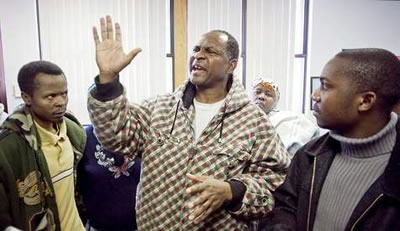 About 100 people crowded into the Omaha Housing Authority office at 30th and U Streets on Tuesday morning to protest recent attacks on Somali Bantu refugees. Among those at the protest are Mnongerwa Moalim, center, who said he was recently assaulted, Abdirahman Noor, left, and Sheikh Mire. |
A group of the refugees began Tuesday angry and ready to retaliate against people they say have been assaulting them in the South Side Terrace Homes public housing development.
They ended the day applauding a set of solutions proposed by City Councilman Ben Gray, Omaha police and Omaha Housing Authority officials.
The solutions included increased police patrols, OHA staff monitoring school bus stops and regular meetings with police gang intervention specialists.
Officials from those groups met with a group of refugees at a two-hour meeting at the South Omaha YMCA.
Gray, who's on the OHA board, put together the meeting in response to a Tuesday morning protest during which more than 100 Somali Bantu refugee families packed an OHA office at South Side, 30th and U Streets.
They protested, including keeping their children out of school for the morning, because four recent beatings had dredged up the fears that have plagued the refugees off-and-on for the past three years.
No one suffered life-threatening injuries in the beatings. However the refugees said, and police reports show, that they were terrifying attacks in which groups of three to seven young men set upon a husband and wife in their 40s, a man approaching 60 and another man in his 40s.
Hawa Elmi, 41, and her husband, Mohamed Noor, said they were accosted and beaten by six or seven young men when they left their house to go to the grocery store.
“They held my husband's hands behind his back,” Elmi said in an interview. “They had something metal in their hands. They started beating him. Then they put my hands behind my back and started beating me.”
Those attacks, on Sunday and Monday, came 10 days after a 20-year-old Somali Bantu refugee was beaten at South Side.
That refugee told police that three young men, possibly gang members, accosted him on his way to a mailbox and demanded money. Then two of them held his arms while the third punched him in the head, according to a police report.
The victims said they knew no reason for the attacks. They also said that eyewitnesses saw the assailants leave and return to a South Side apartment.
“They were trying to retaliate this morning,” said Mohamed Hassan, president of the Somali Bantu Association of Nebraska. “I told them, ‘Don't do anything. Make a protest (instead).'”
Tuesday morning, Gray urged the people squeezed into the OHA office to give him a chance to resolve the issue.
By 5 p.m., he had assembled an impressive group of officials. City Council President Garry Gernandt was there, along with OHA Executive Director Stan Timm, Omaha Police Deputy Chief Todd Schmaderer, Police Capt. Kathy Belcastro-Gonzalez and Jannette Taylor, executive director of Impact One Community Connection, a gang-intervention group.
More than 120 Somali Bantu people, a good half of them children, filled the seats of the John Beasley Theater. Several speakers alluded to their ethnic group's difficult history in Africa. They said they survived civil strife in Somalia by fleeing violence.
“We are not going to let our children take the risk of going to school until something is done,” said Alphonsine Mfwamba, a mother of five. “We have lost a lot of people. Our children are all we have left. We are not going to lose any more.”
An estimated 900 to 1,000 Somali Bantus live in Omaha. Most arrived from 2003 to 2005. Hundreds live at South Side. The Omaha Housing Authority renovated apartments there to accommodate their large families after early arrivals were placed in sub-standard rental houses.
They have had difficulties at times with gang members at South Side, but by all accounts none of them have formed gangs.
Belcastro-Gonzalez said police have to respond to emergencies and can't always make it to calls as fast as everyone would like. She urged the people to work with gang unit officers and others.
Schmaderer said police will print fliers in the refugees' first language about how to report crimes and what happens after a crime is reported.
As the meeting broke up, Tony Espejo, a gang unit officer who coaches a Somali Bantu soccer team, was talking with teenagers from the refugee families.
OHA officials were talking with parents and Omaha Public Schools officials about their plans to make parents feel safe about sending their kids to school Wednesday.
And on the stage, the delegation of Somali Bantu leaders whom Gray had requested was earnestly engaging police and dignitaries in conversation.
Contact the writer:
402-444-1057 , [email protected]