
Sunday, February 17, 2008
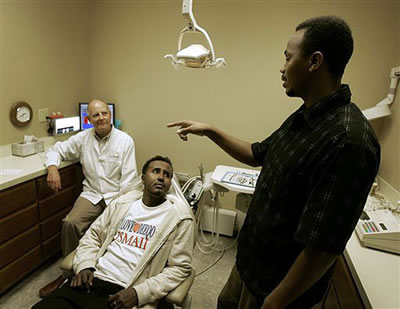 TUCSON, Ariz. (AP) - In a small Tucson apartment festooned with red and green foil decorations, Ramla Ali, a Somali Bantu refugee mother of four, spends most of her days bewildered, frustrated and desperate.
Her husband, Abdullahi M. Iman, also a Somali Bantu refugee, has been held at the Eloy Detention Center for five months for failure to apply for his legal-resident card, commonly known as a green card.
Ali can't understand why her husband, who is legally allowed to live and work in the country because of his refugee status, is being kept from his family.
``I need him back,'' she said tearfully.
The two men were detained by Tucson police last year in separate incidents.
Police arrested Iman, 35, on domestic-violence charges on Sept. 3, a police report said. Police arrested Bere on Aug. 9 on suspicion of assaulting his roommate, another Somali refugee, said Officer Frank Amado, spokesman for the Tucson Police Department.
Currently there are no charges pending against Iman or Bere, according to Tucson police and Erin Maxwell of the Florence Immigrant and Refugee Rights Project, a pro-bono legal-support group.
When it was discovered that Iman and Bere had not met the green-card requirement, Immigration and Customs Enforcement officers took them into custody.
The immigration hold on Iman and Bere - and their possible deportation - has Tucson's Somali Bantu community nervous, said Barbara Eiswerth, coordinator of the Iskashitaa Refugee Harvesting Network, an African refugee support organization in Tucson.
``It's absolutely not living the American dream,'' Eiswerth said.
Ali and her husband lived in a squalid, sprawling refugee camp in Kenya for 12 years before coming to America in 2004. The Bantu are descended from slaves from neighboring countries and are not a traditional Somali ethnic group. They fled because of ethnic cleansing during the 1991 Somali civil war.
Bantu refugees were assaulted and raped in the camps. In 1999, the U.S. government declared the Bantu a ``persecuted minority.''
Five years ago, the United States began admitting about 15,000 Somali Bantu, said Dan Van Lehman, co-director of the National Somali Bantu Project at Portland State University in Oregon. The Somalis underwent medical and other inspections and were resettled across the country in about 45 cities in 38 states, he said.
In Tucson there are an estimated 800 Somali Bantu refugee adults and their children, some of whom were born in the U.S., Eiswerth said.
Van Lehman said the Somali Bantu are adapting and coping as well as they can, considering the cultural, language and financial challenges. Iman and Bere were working, Eiswerth said.
But Van Lehman is unaware of any other Somali Bantu being held in immigration facilities for failure to apply for a green card.
Refugees are required to ``adjust'' their legal status within a year after their arrival to become legal residents in compliance with Section 209 of the Immigration and Nationality Act, said Vincent M. Picard, spokesman for ICE of the Department of Homeland Security in Phoenix.
Picard could not provide any more information, citing the men's privacy rights.
Eiswerth said many Tucson Somali Bantu refugees know about the green-card requirement, but language and financial barriers keep them from complying.
Bere doesn't read or write, said his brother, Hussein Ali, who lives in Tucson. Both men came to Tucson in 2004.
Maxwell, of the refugee-rights group, said Iman and Bere will remain in detention until their green-card applications are approved. That could take up to a year, and if their applications are denied, they would face deportation hearings, Maxwell said.
Iman has started the process, but Bere has not, she said. The application process requires that they have up-to-date immunizations and pay various fees, Eiswerth said. Those can total several hundred dollars.
Moreover, Iman and Bere cannot be released on bond because they are considered undocumented, although they entered legally, Maxwell said.
The uncertainty has Ali in anguish. She has seen her husband twice in Eloy.
In her apartment behind the Trini Alvarez-El Rio Golf Course, Ali cares for her four children, ages 9 months to 8 years. Two of the children attend Tully Elementary Magnet School. Three of them were born in the refugee camp.
``The children are afraid to go to school. They cry for him,'' Ali said through an interpreter.
She can't pay the bills and speaks little English. She is disillusioned.
The United States brought them here, and the U.S. put her children's father in prison, she said.
Eiswerth and Somali supporters collect food, diapers and clothes for Ali and her children, and money for his immunizations and green-card fees. But with her husband indefinitely held in detention, Ali said she remains fearful.
``We came to live in peace and to live a better life,'' she said. ``This is like killing my family.''
Source: AP, Feb 17, 2008