by Osman Dahir Osman
Thursday, September 27, 2007
The
|
Landing Station |
The objectives of the project are to establish a broadband optical fiber network that will link East African countries (both landlocked and coastal) as well as to link to SAT3/WASC/SAFE. The fiber optic project, which will complete the fiber optic ring surrounding 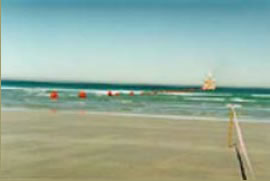 investors, universities and regional bodies like the New Partnership for African Development (NEPAD) secretariat. The African Universities Association, for example, is investing in the project to buy bandwidth capacity for its members.
The decision to embark on the EASSY project was made due to the high cost of bandwidth Internet connection into African countries, especially those on the Eastern corridor. Other financiers of the project are the telecommunication operators in the region, the World Bank and NEPAD, among others. It is worth noting that
Problems facing the EASSY PROJECT Mogadishu is the only landing station in Somalia
There are some implementation problems facing the EASSY project such as the misunderstandings among the members of the consortium with regards to the “open access” policy being canvassed by one of the members of consortium. NEPAD- e Africa Commission insists that to enhance cheap Internet access in
The other business partners of the consortium are not in agreement with the policy. They also insist that the project should be run like a business entity to maximize profit. (Perhaps change previous two sentences to the 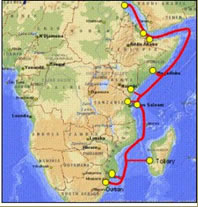 other business partners of the consortium are not in agreement with the policy as they insist that the project should be run like a business entity to maximize profit) They further insist that only telecommunication companies and Internet Service Providers with international gateway licenses to be allowed to become members of the network. This impasse among members has resulted in a delay in the commencement of the project.
Due to the delay of the project,
Local Telecommunication operators of EAASY Project
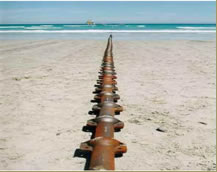 The cable, known as EASSy, will run 10,000 kilometers from the continent’s southern tip to the African horn, connecting
African nations can utilize these opportunities to match up with international telecommunication operators worldwide. For example, the links from Europe and Asia to
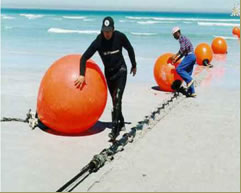 The fiber optics networks will afford Africans the opportunity for broadband connectivity that will ensure fast delivery of video, voice and data for business, banks, governments, television companies, media conglomerates, oil exploration and mining companies, among others. The digital technology of fiber optic networks will also make it easier and cheaper for social services to be rolled out across the continent through the use of such applications as telemedicine, distance education and access to the World Wide Web. Being the main hub of the SAT3/WASC/SAFE project in Africa, recent findings show that
The economic and business opportunities available for the fiber networks are enormous. As discussed under the current update of the SAT3/WASC/SAFE project, the International Finance Corporations study findings show how the existence of the fiber cable network is facilitating the growth of foreign investments, employment, and business opportunities in the four
Foreign firms and companies can also use the fiber optic networks to outsource or sublet some of their business operations to
Furthermore, proper utilization of fiber optic networks in
This can also facilitate creation of countless jobs and the opening of numerous opportunities for African and international entrepreneurs alike.
Fiber optic networks in Africa can provide opportunities for international business to invest in such areas like telecommunication so that cellular phones, video games, and other interactive digital software and hardware industries can grow in
What is Next
The Fiber Optic initiatives in
In addition, the initial misunderstanding of the EAASY project by the members of its consortium is also creating unnecessary tension. Hence,
There is the need to speed up the proposed integration and rationalization plan of
Linking the project to terrestrial and satellite networks will also afford opportunity to businesses and other multinational corporation to have reliable broadband connectivity in the event of service interruptions or any adverse weather effects that can cause damage to satellite dishes or terrestrial antennae. Furthermore, the linkage will also go a long way safeguarding
What is Fiber Optics?
Fiber optics or optical fibers “are thin strands of glass or plastic capable of transmitting large quantities of information over long distances with little signal loss. “Fiber optic communication is based on the principle that light in a glass medium can carry more information over longer distances than electrical signals can carry in a copper or coaxial medium. From the two definitions, one can see that fiber optic technology is based on a glass fiber medium that allows transmission of digitized light signals to carry information over long distances with few transmission losses.
How Does Fiber Optics Work?
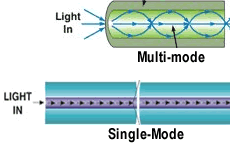 Fiber optics use light as a method of encoding a transmitted signal. A standard fiber optic link consists of three parts, which includes a light source, optical fiber as the primary transmission medium, and a transducer (receiver/detector). The light source is a Light Emitting Diode (LED) or laser. The LED modulates an incoming electrical signal into an optical signal. The optical fiber consists of two layers of different types of glass surrounded by a protective acryl ate coating. “The two layers are the core and the cladding. The light is guided through the core region where it is detected at the receiving point. At the receiving end, the transducer converts the optical signal back into an electrical signal. Fiber optics technology transmits information by changing electronic signals into light signals.
Fiber optics are used in three distinct communication environments, namely, long-carriage inter-exchange telephone communications, in combination with coaxial cable to serve as the backbone for modern cable television systems in a configuration referred to as “hybrid fiber/coax,” and fiber optics used in local area networks for data distribution. In relation to types of fiber optics, there are two types, namely, multi and single mode. The multi mode has a larger core than that of the single mode.
The multi mode allows hundreds of modes (rays) of light to go through the fiber at the same time. It is worth noting that multi mode fibers are ideal for short distance applications or local area networks where the links are usually less than three miles in distance and can accommodate many connectors. A single-mode fiber has a smaller core that allows only one mode of light at a time to propagate through the core. Single mode fibers are designed for a long distance application such as long carriage telephone trunk line applications that require high bandwidths.
Advantages Fiber Optic Systems have over other Transmission Media.
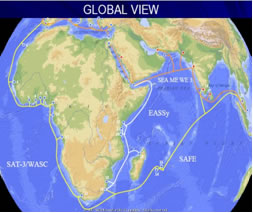 The use of fiber optic technology has certain distinctive features over other means of communication. In terms of broad bandwidth capability, fiber optic systems offer users more potential bandwidth than any other type of transmission medium. “An actual fiber strand is a few microns wide in diameter, or the equivalent of 6/1,000s of inch thick. When bundled together in a duct or passageway, the combined bandwidth provides more than sufficient capacity for most voice, data and video applications.” This means that fiber optic cables are capable of transmitting very large volumes of data, audio and other multi media applications when compared with copper wire with dial-up connection. In addition, the fiber optics cables offer room for future expansion at minimal extra cost and without the need for excavation or construction and lying of new cables. This is also an advantage for telephone communications companies looking for continued steady growth in the types of services they offer and demand for more.
Fiber optic systems are not prone to electromagnetic interference as are telephone twisted pair wires, coaxial cables and satellite. This is because the transmitting medium is non-magnetic. Thus, the fibers cannot pick up electromagnetic interference from generating plants, electric cables, and other sources of high electricity voltage lines.7 Fiber optic cables are robust and durable. They are also resistant to extremes in weather and temperature. Due to their flexibility, they are ideal for installation in places like subway routes, culverts, elevator shafts or any aerial conditions. Furthermore, fiber optics cables can achieve higher speeds for voice data and video transmission than any other transmission medium. Modern multimode fiber cables can transmit at speeds between 100Mbits/s and 622 Mbits/s depending on the transmission.
Fiber optics cables do not emit radiation; therefore they do not interfere with other media. Unlike the satellite, telephone or cable connection, a broken connection which is wire tap can be detected within a few inches. Thus, if there is any damage on the system it could easily be found and repaired. In terms of cost of production, fiber cables are inexpensive. One of the reasons for this is that the primary source of raw material is sand. Furthermore, fiber optic cables tend to be lighter than other telecommunication; in addition, fiber optic cables allow transmission of signals over long distances with few amplifiers. Within this medium attenuation is very low.
Arguments against Fiber Optic Technologies
It should be noted that in reviewing sources for the researched paper, it became clear that some authors question the claims that satellite communications are less secure than fiber optic. “All new satellite systems are based upon digital multiplexing systems. For that matter digital systems are difficult to intercept, especially if encryption and encoding systems are used to enhance security.” He also argued that there are at least five methods that can be used to intercept a message on fiber optic systems. To dispute the claim that fiber optic cables are immune to interception, he writes that, fiber cables can be “cross-sectioned, and eavesdropped.” Halley (1987) also writes that the fiber optic system can cause damage to human eyes, if proper care is not taken to protect the eyes in the course of installing the system. According to this author, “The densities of optical energy emitted by the light source and by the extremity of the fiber are sufficient to damage the retina permanently before the victim notices.” He therefore advocates the wearing of “infra-red” glasses when working near the “operational equipment.” Despite Pelton’s arguments concerning shortcomings of fiber optic technology, there are some satellite companies that blend both satellite and fiber optic technologies.
For example, the Pan America Satellite Company (PANAMSAT) provides both satellite and fiber optic technology in a quest for more integrated distance telecommunication. PANAMSAT’s fiber optic network links its North and South American satellite’s to European countries. The same opportunity could also be provided to African countries to better integrate their telecommunications sector.
The Prospects for Fiber Optics Initiatives in
Several initiatives have been taken to connect the African continent with submarine fiber optic cables to enable
The Third Southern Africa Telecommunication /
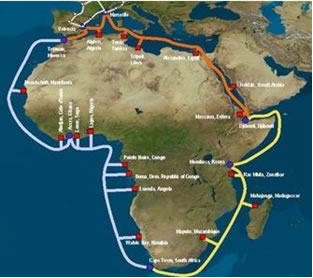 SAT3/WASC/SAFE was launched on May 27, 2002, in
Update on the SAT/WASC/SAFE Project
Since its inception in 2002, The SAT/WASC/SAFE project has created many opportunities for African countries. The project enhanced access to Information Communication Technology (ICT) services among the beneficiary nations. For example, increased access to bandwidth on the broadband Internet has enhanced speed of transmission of data, voice and other interactive multimedia applications in countries like
In addition, the project is helping the member countries to reap benefits in Business Process Outsourcing (BPO) and off-shore ventures. For example, the availability of the SAT/WASC hub in
The SAT3/WASC/SAFE project is also benefiting landlocked countries in
Problems facing the SAT/WASC/SAFE Project
The SAT/WASC/SAFE project is not having the desired impact on African countries due to several factors. The project has been criticized by telecommunication experts for not solving the high costs associated with broadband access in the African countries to which it connects. South Africa Telecom, the main managers of the SAT3/WASC project, has kin intensifies for monopolizing the determination of bandwidth charges.30 Telecommunication analysts indicate that bandwidth subscription fees are very high, starting from US$ 25,000 for megabytes per second for a month rates.
Furthermore, scattered and uncoordinated infrastructure investments have created problems of unused networks in most of the landing locations. Uncoordinated efforts and duplications of fiber optics initiatives in several African countries have resulted in the under-utilization of the SAT/WASC/SAFE network. The inability by telecom operators to equitably distribute the bandwidth has resulted in a situation where most of the local fiber optic networks are concentrated in urban areas leaving the rural areas undeveloped. According to an International Finance Corporation report (2003), among the four West African countries surveyed, (
Another problem with SAT/WASC/SAFE project is that the transactions of the consortium are not open to non-members. Membership is limited to “close club members.” Furthermore, the shares or equities of the consortium are easily trade able. The failure of SAT3/WASC/SAFE to solve the problem of high cost of bandwidth is among the reasons why another fiber optic project was proposed. This project is known as Eastern African Submarine System. [i]
Conclusion
In conclusion, in
Osman Dahir Osman
Somali Internet and Communications Technology (SICT)
Email:
[i] 1 See Mail and Guardian: “
2 See High Commission of India website “ Bilateral Trade and Economic Relations” Retrieved on May, 17 2006 at http://www.indiahc-ghana.com/business.htm
See NEPAD E Africa Commission website: “Origin and Overview”: Retrieved on May,17 2006
3Jensen M, and Soderberg, B (2003) Investment Opportunities in West Africa/ICT and Internet Services: Regional Analysis. International Finance Corporation. (p.10)
4 See Infodev website: “Leveraging New Technologies and Open Access Models: Options for Improving Access in Developing Countries with Focus on Sub Saharan Africa. Published on February 17 2004 Retrieved on May 15 2006 at www.infodev.org
5 See Oyuke J. “Govt. firm clash over Sh 15b Project.” The Standard online posted on May, 9 2006. Retrieved on May, 17 2006 at http://www.eastandard.net/hm_news/news.php?articleid=1143952234
6 See Mail and Guardian on line: “(Broad) banding together”. News article posted on March, 31 2006. Retrieved on May, 15 2006 at www.mg.co.za/articlepage