
Sunday, May 06, 2007
 |
|
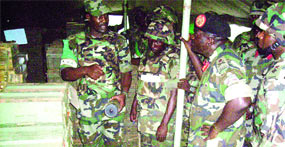
Lt. Gen. Katumba Wamala (second right) inspects the weapons surrendered by residents of Mogadishu last week |
"We have received 2,128 mines, three technicals, 201 SMG rifles, six pistols, four 12.7mm guns, three 23mm guns, one 76mm gun and one anti-aircraft gun," said the spokesman for the peacekeeping force AMISOM, Capt. Paddy Ankunda, from Mogadishu last night.
"The weapons are being brought in mainly by members of the business community. We did some mobilisation and they have responded to our call to disarm."
Asked what would happen to the weapons, he said: "We register and document them and keep them in safe custody. In due course, they will be destroyed in the presence of the public so that there is no suspicion that they will end up in the hands of another clan."
The voluntary disarmament is a sign of confidence that peace is returning, Ankunda said. "We know that there is a plan of some elements to use land mines and car bombs to disrupt the present peace. But so far they have been unsuccessful. In the last week we were able to disable three landmines which had been reported to us by civilians."
He called upon other countries which promised to contribute not to let this momentum pass. "The only thing which is missing is for the other contributing countries like Nigeria, Burundi and Ghana to move in. If they could come here soon, they could tap into this support."
In a separate move, Somalia's armed forces, backed by Ethiopian soldiers, are carrying out regular security sweeps meant to reassure the population of the capital, AFP reports.
With direct combat having ended over a week ago, they have turned their attention to searching for arms caches and rooting out rebels in an effort to consolidate control over the city.
They have also multiplied road blocks, closing some districts off to traffic.
The insurgents, remnants of the Union of Islamic Courts, remain opposed to the government presence, however, and have formed ad-hoc alliances with clan fighters.
According to a Somali human rights group, around 400 people - most of them civilians - died in the last rounds of fighting, in which soldiers sought to stamp out the insurgency.
The fear among many of Mogadishu's inhabitants is that the current attempt to instill order will not hold, and open violence will return. Their determination to hold on to weapons despite the disarmament push has complicated the army's efforts.
Mohammed admitted that bringing security back to the city was slow going. "We have to search house by house. It takes a long time," he said. "Every day we find bombs, landmines." He added that 200 people had been arrested in recent days. But the government's policies in trying to impose security on Mogadishu - a city that has been living in armed chaos since 1991, when it became prey to feuding warlords - has raised hackles.
"Peace behind the tanks is not real peace," Ali Mohali Mohammed, the chief administrator of the city's Medina hospital, told AFP.
Mogadishu's security problem "will not be solved by force," he said, reflecting a common opinion in the capital. He added that negotiations should instead take place.
The government has shown little patience for that line of reasoning, arguing that the first step to peace is by eliminating the rebels, behind which it claims Al-Qaeda lurks.
Only then, it claims, the conditions will be right for the long-awaited "national reconciliation conference," which is now scheduled for mid-June.
Source: New Vision, May 06, 2007