
Tuesday, March 27, 2007
MOGADISHU (AFP) - Like most teenagers of his age, 17-year-old Ahmed has great hopes for the future, even though his past is filled with the nightmares of Somalia's bloody inter-clan power struggle.
"I dream of going to university and becoming someone important," Ahmed said, although fighting and a lack of government have forced higher education institutions in Somalia to be closed for years.
Surrounded by death, revenge attacks and urban warfare, Ahmed and his friends identify with elements of hardcore rap hailing from the tough suburbs of US cities.
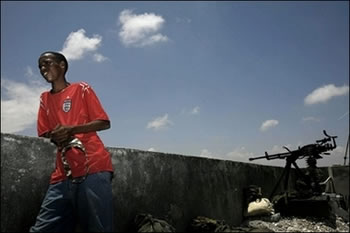 |
| Ahmed, 17, stands on the roof of a building occupied by the African Union troops to monitor the situation in the center of the Somali capital Mogadishu 24 March 2007. Hundreds of families took advantage today of a rare period of calm to flee the Somali capital after deadly clashes last week which claimed 24 lives. At the K4 junction of southern Mogadishu, a Ugandan contingent of African Union peacekeepers deployed to help government troops regain control, held their positions, some on top of buildings.(AFP/Jose Cendon) |
In times of war as in peace, speakers in Mogadishu neighbourhoods blare out distorted tracks from foreign Hip Hop stars.
Ahmed lives with his uncle. Eight years ago his father left home one day and did not return.
"One day, he said he was going to graze animals in the bush, we do not know anything about what happened next," he said, trailing off. "But I am sure ... I know he is not dead."
His mother and four sisters have migrated to the relative safety of the northern breakaway republic of Somaliland.
"Sometimes, they send me little money, but it is hard," he said. "Sometimes I dream that I have enough money to send my mum abroad with my four sisters, either in Canada or Europe, for them to be safe."
Ahmed was born barely one year before former dictator Mohamed Siad Barre was toppled in 1991, plunging the country into chaos.
Many young men like Ahmed have been conscripted into militia ranks where they are increasingly risking their lives. Suspected Islamist insurgents battle with Somali troops on an almost-daily basis in Mogadishu.
Last week saw some of the deadliest fighting there since Ethiopian and Somali troops drove out an Islamist movement over the New Year.
Since the start of the year the violence has since claimed dozens of lives, and forced thousands more to flee.
But Ahmed is not tempted to join a militia.
"I am afraid of them because I have already lost my brother to the war. I am afraid of the people with guns. They can rape your sisters in front of you. They can kill you like dogs," he said.
Ahmed's biggest hope for the future now lies with Ugandan peacekeepers, part of an African Union force that is the latest attempt to restore normalcy to the troubled Horn of Africa nation.
The AU mission is the first international peacekeeping venture since US troops led an ill-fated UN peace operation more than 10 years ago.
"When I saw the Ugandans I was relieved," Ahmed said, after the troops arrived at the beginning of March.
But so far only 1,500 Ugandan troops have deployed, part of a planned force of around 8,000, which the AU is struggling to assemble.
"But I can see they are so few, I don't know what to think," Ahmed said. "The militias can attack them and then we will be in danger again."
Source: AFP, Mar 27, 2007