
By IAN BURUMA
Saturday, March 03, 2007
Hirsi Ali’s stated aim was commendable, even if her claim that this “is the largest, most important issue that our society and our planet will face in this century” is perhaps a trifle overblown. But her choice of words is curious. Why a “holy” mission? By her own account in “Infidel” she “had left God behind years ago.” Once a devout Muslim, she was now an atheist: “I was on a psychological mission to accept living without a God, which means accepting that I give my life its own meaning.” Hence the title of this fascinating account of her life.
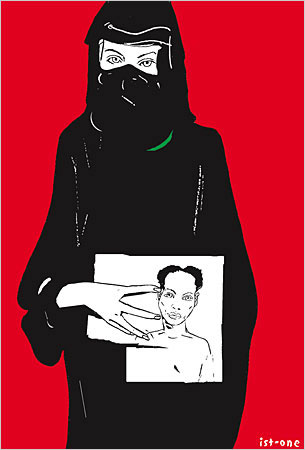 I know from having spoken to her on several occasions that she resents people attributing her views, including her conversion to atheism, to her personal experiences. She insists that she arrived at her opinions intellectually, and not because she was traumatized, say, by being painfully circumcised as a child, or brutally beaten by her religious instructor or tormented by guilt whenever she was touched by a boy. Still, this is a book about her life, not a very long life so far. But what a life!
Born in Somalia, the daughter of a politician who opposed the Siad Barré dictatorship, she grew up with oppression. Instructed to remain silent when other children sang Barré’s praises, she was beaten by her teacher. She was also bullied by girls at her Koran school, but not as badly as a fellow pupil who was beaten mercilessly for being a kintirleey, that is, “she with a clitoris,” that is, uncircumcised. Female circumcision is practiced in certain parts of Africa, among Muslims as well as others, but is not an Islamic custom as such. Hirsi Ali’s strict grandmother believed that girls who were not subjected to this painful practice would be possessed by devils. And so Ayaan and her sister had their genitals cut.
Because of her father’s politics, which frequently landed him in prison, the family went into exile, first to Saudi Arabia, where Hirsi Ali was confronted by a harsher, crueler form of Islam than in Somalia, as well as Arab racial discrimination. As dark-skinned Africans, Hirsi Ali and her sister were called “slaves.” But then, in 1980, when the family moved to Kenya, after a short sojourn in Ethiopia, Hirsi Ali’s own mother called the Kenyans slaves, because they weren’t Muslims and “looked different.” In Nairobi, a noisy, colorful, squalid city, Hirsi Ali, as a high-school student, fell under the spell of militant Islam and began to wear a black hijab, covering herself from head to toe. No one forced her. “It had a thrill to it,” she writes. “It made me feel powerful. … Weirdly, it made me feel like an individual. It sent out a message of superiority: I was the one true Muslim.” Not a bad description of what is becoming an increasingly common feeling among young Muslims in many places, including Europe.
At the same time, Hirsi Ali was fascinated by glimpses of a freer life, mere fantasies really, imbibed from romantic novels by Danielle Steel and Barbara Cartland: “Buried in all of these books was a message: women had a choice.” It was in this spirit that she decided to flee from a forced marriage with a Somalian from Canada. On her way to join him, she stopped off in Germany, took the train to Amsterdam and claimed to be a refugee from the Somali civil war. She arrived in the Netherlands in 1992, not speaking a word of Dutch. In 2003, she was perhaps the most famous politician in the Netherlands. In 2004, she wrote “Submission,” a short film about female oppression under Islam that led to the murder of its director, Theo van Gogh. In 2005, Time magazine listed her as one of the 100 most influential people in the world.
The underlying theme of this remarkable tale is sexual repression and gradual liberation. Not only was an uncircumcised woman treated as a demon in her clannish society, but Hirsi Ali was called “filthy prostitute” by her own mother when she had her first period. She was tortured by guilt when she was kissed for the first time by a Kenyan boy. Even in the Netherlands, she still felt disgusted by Ethiopian girls because they revealed their legs. But finally she rebelled against the duty of Muslim women to submit to Allah, and to their fathers, brothers and husbands. Hirsi Ali feels that she was set free, sexually, socially, intellectually, by the West, starting with Danielle Steel.
Source: New York Times, Mar 03, 2007