
By Patrick Worsnip
Friday, April 20, 2007
 |
|
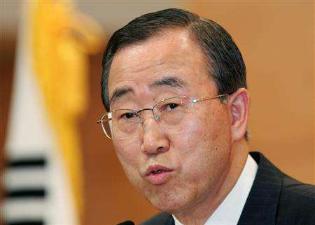
UN Secretary-General Ban Ki-moon |
In a report to the Security Council made available on Friday, Ban called on the 15-nation body to consider in June whether a conventional U.N. peacekeeping force could succeed in the lawless East African country or something more was needed.
Ban said a U.N. force might work if fighting stopped in south-central Somalia and all or most armed groups and communities signed up to an agreement allowing for outside monitoring.
But if the political process fails and violence gets worse, "alternative options, including peace enforcement, should be considered," he said.
"An operation, mandated by the United Nations, mounted by and composed of a coalition of the willing with the appropriate capabilities to deal with the high paramilitary threat, would be better suited" to such a situation.
The term "coalition of the willing" refers to a group of like-minded countries that decide to take action in a trouble spot but are not under U.N. control.
Ban's report, which will be discussed by the Security Council next Tuesday, came as fresh shelling and gunfire shook Mogadishu and an exodus of residents from the Somali capital gathered pace.
Somalia has been a byword for anarchy since the fall of dictator Mohamed Siad Barre in 1991. Islamist militia captured Mogadishu from warlords last year, but were ousted over the New Year by the forces of the Western-backed interim government of President Abdullahi Yusuf, bolstered by Ethiopian troops.
Since then an insurgency blamed on the Islamists has grown in Mogadishu, challenging Yusuf's effort to restore central control.
But outside intervention in Somalia has a checkered history. The killing of U.S. troops in Somalia in late 1993 in the so-called "Black Hawk Down" incident marked the beginning of the end for a U.S.-U.N. peacekeeping force that quit Somalia in 1995, and influenced U.S. policy for years.
Ban urged the Security Council to look again at the situation in mid-June to see if a U.N.-backed reconciliation process that Yusuf's government is trying to launch had made enough progress to allow a U.N. peacekeeping operation.
But his report admitted that such an operation would be fraught with problems ranging from security to logistics.
Source: Reuters, April 20, 2007