By A Correspondent
The EastAfrican
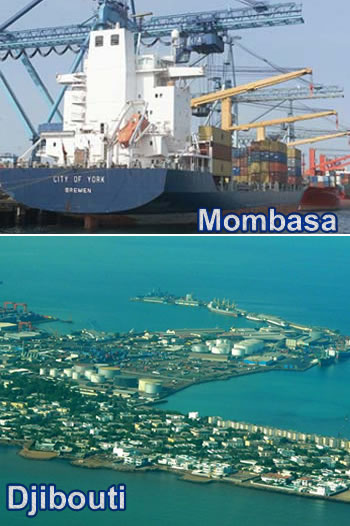 Djibouti has embarked on an ambitious programme that may see Mombasa knocked off its perch as the eastern seaboard’s main port, with multimillion-dollar investments lined up to expand the small Red Sea nation’s container and oil terminal capacities.
Sources say the Kenya Ports Authority is watching the improvements at the Doraleh port, which will include the construction of a two-kilometre jetty and a $400 million container terminal with interest. Work on the latter began last week. With just four container terminals and 10 cranes, the port currently has a capacity to move 400,000 container units per year and 10 million tonnes of general cargo.
The first phase of Doraleh’s expansion, which is situated just 10 kilometres from Djibouti’s capital, started earlier in the year. It involves the construction of a $130 million oil terminal with a capacity of nearly 400,000 cubic metres. Plans are also underway to turn the port into a duty-free zone.
The developments are the results of a strategic plan was launched in 2000, when the Djibouti government invited Dubai’s DP World - one of the world’s leading port companies - to partner in the expansion project. DP World has undertaken to complete the upgrading by 2008.
The Djibouti government hopes that the port will eventually become the key economic engine for the 800,000 inhabitants of the resources-poor desert country.
The emergence of Doraleh port as a major player in the Horn of Africa is expected to offer stiff competition to Mombasa, traditionally the dominant cargo hub in the region.
Mombasa serves more than half a dozen countries including Kenya, Uganda, Rwanda, Burundi, Democratic Republic of Congo (DRC), Southern Sudan, Ethiopia, Somalia and northern Tanzania. Today, the Kenyan port handles more than 15 million tonnes of cargo each year.
Facilities at the premier Kenyan port include a deep-water port with 21 berths, two bulk oil jetties and dry bulk wharves that can handle all size ships. It also offers specialised facilities such as cold storage, warehousing, and container terminals.
In the fight for market share, the Kenya Ports Authority (KPA) is likely to point out that the port of Doraleh does not have an adequately developed hinterland infrastructure, including rail-lines and roads, to transport goods into and from the interior. The political situation in the Horn of Africa, where Ethiopia and Eritrea have remained in a state of war, will in the short-term make full exploitation of the new facilities difficult to achieve which will also favourMombasa.
Besides, says the KPA, a large part of the 500-kilometre road linking the port to Nairobi has re-built. Kenya and Uganda also recently jointly concessioned their railway systems to a South African consortium in an attempt at making the service more efficient in moving cargo to-and-from the port.
Recently, the port of Mombasa has also invested heavily in modern equipment including cranes and tugs, as well as reducing bureaucracy and pilferage to remain competitive. The port has also embarked on a marketing blitz to change its image as a corruption-prone backwater. Just last week,
KPA signed a memorandum of understanding on behalf of the port with Malaysia’s Port Klang Authority (PKA) meant to enhance trade between the two ports.
Source: The East African, Dec 05, 2006